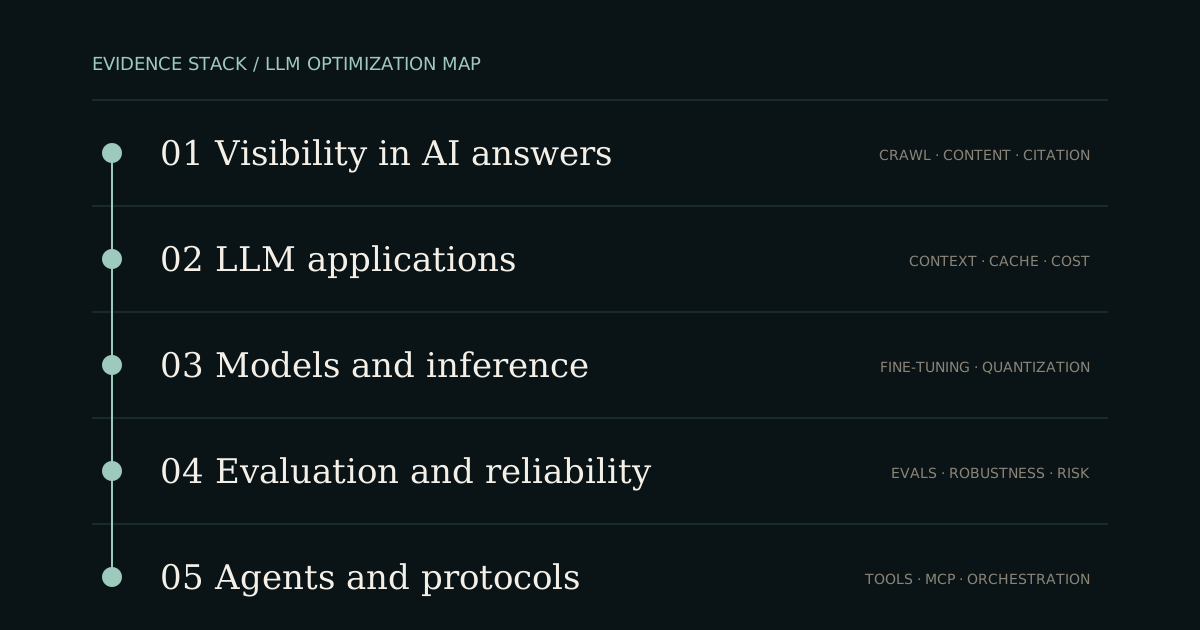
Disambiguation map

“LLM optimization” describes five different jobs.

Optimizing a page for AI answers, reducing the cost of an application, compressing a model, evaluating reliability or connecting an agent to tools requires different teams, evidence and metrics.

5 distinct objects6 primary sources1 local calculator0 ranking promise
Map of five disciplines: AI visibility, LLM applications, models, evaluation and agents
The Evidence Stack column is a reminder that every optimization needs an appropriate metric and limitation.

How do you choose the right discipline?

Complete this sentence first: “we optimize ___ to improve ___, measured by ___”. If the first blank is a web page, the task is probably AI visibility. If it is a pipeline or API, it is application optimization. If it is model weights and inference, it is model optimization.

This prevents content advice from being applied to a GPU constraint, caching work from being called GEO, or an evaluation score from being presented as proof of organic visibility.

Optimized objectDefensible metricsTypical ownersStarting point
Page or websiteIndexing, impressions, observed citationsSEO, content, webLOOP method
LLM applicationTask quality, cost, latency, cacheProduct, AI, platformRequest logs and evals
ModelBenchmark quality, memory, throughputML engineering, researchReproducible baseline
Evaluated systemError rate, robustness, riskQuality, security, domainVersioned test set
AgentTask success, tool errors, costProduct, engineering, securityTool contracts and traces
01
AI answer visibility

Make a page accessible, understandable and citable

This discipline acts on a website and its content. It covers crawling, indexing, structure, topical authority, self-contained passages, entities and the measurement of observable mentions or citations. This is the historical core of llmoptimisation.fr.

Google’s guide for generative Search features points back to SEO fundamentals: crawl access, indexability, textual content, internal links, page experience, images and videos, and structured data that matches visible content. Google also says no special file or Schema.org markup is required for these features.

Use the website optimization path, then keep measurement separate through the observatory.

02
LLM applications

Optimize context, routing, latency and cost

An LLM application should be optimized as a measured software system. Model choice, context construction, retrieval, tool calls, caching, rate limits and observability need to remain connected to quality evaluations.

OpenAI documents prompt caching for repeated prefixes and exposes cache usage. Google also documents context caching for Gemini. Availability, pricing and thresholds are platform-specific and must be checked at implementation time.

03
Models and inference

Fine-tuning, quantization, distillation and benchmarks

The optimized object is now the model or its execution. Quantization represents weights, and sometimes activations, with lower precision to reduce memory use and potentially improve inference performance. The trade-off must be evaluated on the target tasks and hardware.

Hugging Face Transformers documents multiple methods, hardware targets, precision levels and calibration requirements. Its overview makes the selection problem explicit: methods have different trade-offs and compatibility.

Minimum weight memory estimate

About 3.73 GiB for 8 billion parameters at 4 bits, weights only.

Displayed formula: parameters × bits ÷ 8, converted to GiB. It is not a benchmark.

04
Evaluation and reliability

Measure before declaring an improvement

An optimization only exists relative to a criterion. Evals formalize inputs, expected outcomes, graders, versions and results to compare prompt, model, context or tool changes. Important failures and regressions belong in the test set.

OpenAI documents a reproducible evaluation workflow. NIST AI RMF and its Generative AI Profile provide a voluntary framework to govern, map, measure and manage risk. Neither turns an internal score into a general safety claim.

05
Agents and protocols

Connect models to tools without confusing access with reliability

An agent orchestrates a model, state and actions. Optimization covers tool selection, input and output contracts, permissions, memory, error recovery, cost and end-to-end task success. The model is one component of the system.

Official documentation defines MCP as an open-source standard connecting AI applications to data sources, tools and workflows. Interoperability does not evaluate server quality, action safety or result relevance.

The next high-value work is not another series of generic definitions. It is original testing of tool failures, output contracts, cost per successful task and negative results.

Disambiguation questions

Short answers worth retaining

Does LLMO always mean optimizing a website for ChatGPT?

No. Depending on context, LLM optimization can target content visibility in AI answers, the performance of an application using a model, or the model itself. Name the optimized object and the metric before choosing a method.

Do Google AI features require special markup?

Google says its established SEO fundamentals continue to apply to AI features and that no special file or Schema.org markup is required to appear. Structured data should match visible content and comply with its own policies.

Do quantization and prompt caching solve the same problem?

No. Quantization lowers the precision used to represent model weights or activations. Prompt caching reuses already processed prompt prefixes for repetitive requests. They operate at different layers and require different quality checks.

Why separate evaluation from cost optimization?

Lower cost or latency does not prove that quality remains acceptable. Evals test important behaviours with explicit cases, criteria and versions. Infrastructure metrics and quality results should remain separate.

Is MCP a search engine or ranking system?

No. Model Context Protocol is an open standard for connecting AI applications to data sources, tools and workflows. It belongs to integration and orchestration, not page ranking in Google or an answer engine.